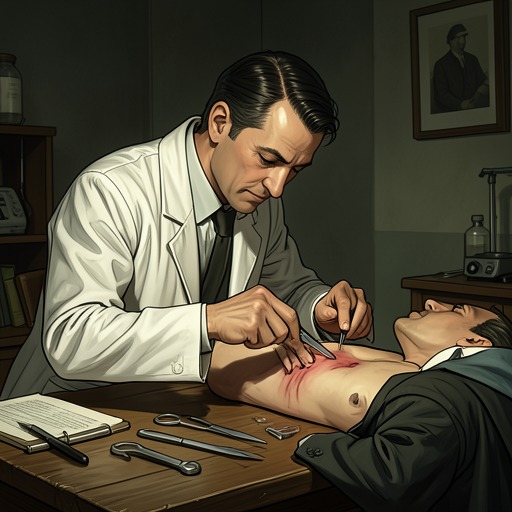
Psychotherapeutic Institute at Vigny-sur-Seine
Journey to the End of the NightThe Psychotherapeutic Institute at Vigny-sur-Seine is Dr. Baryton’s asylum, advertised as a “Rest Home” and sustained by a steady flow of patients and their families. For Ferdinand, it becomes both a precarious place of employment and a close-up view of institutional life: patients are watched, treated, and managed, while the establishment itself must answer to family demands, business pressures, and its director’s desire to escape. Its calm garden and orderly routines do not place it outside the novel’s world of coercive institutions; they give that world a gentler appearance.
Establishment and Business
The institute is already operating successfully when Parapine helps Ferdinand find work there. Parapine’s duties include taking patients to the movies and conducting scheduled electrical treatments for groups of melancholic patients in a sealed, dark room. The procedures are described as a therapeutic innovation devised by Baryton, although the account stresses the practical and commercial arrangements around them as much as their medical purpose. Baryton hires Ferdinand at a very low salary and binds him with a lengthy contract drafted to favor the employer.
The institute’s prospectuses call it a “Rest Home” because it stands in a large garden where patients can walk on fine days. Its grounds are an important part of its public identity: the place is full, and the setting helps make it attractive to families. The patients Ferdinand observes move through the garden with difficulty, while their thoughts and private preoccupations remain intensely important to them. The contrast between the reassuring name and setting, and the patients’ dependence on the institution, is central to the novel’s presentation of asylum life.
The institute is also a business embedded in its locality. Baryton buys food wholesale in Paris, which contributes to the shopkeepers’ hostility toward the establishment. Later, the pressures on the business become more explicit: families want newer and more impressive treatments, while competing institutions seek to attract the wealthier clientele. Baryton responds by having Parapine help modernize the institute with discounted secondhand electrical, pneumatic, and hydraulic equipment. The machinery is acquired less as evidence of demonstrated benefit than as a way to appear better equipped and satisfy demanding customers.
Care, Routine, and Control
The institute’s daily order combines practical care with supervision. Ferdinand and the other staff take a lengthy roll call at dusk, escort the boarders to their rooms, and make rounds to keep patients’ conduct within limits, particularly before Sunday visits from families. The rules are shaped not only by the patients’ needs but also by the establishment’s reputation: what relatives might see matters to the institution. Ferdinand administers an anti-masturbation syrup he had previously used while treating Bébert, and says that he retained the formula and eventually came to believe in it. That recurrence links his earlier medical work to the institute’s routine management of patients.
The narrative presents this kind of oversight alongside more explicitly institutional forms of observation elsewhere. During the war, wounded men whose patriotism was regarded as impaired were held under watch at a secondary school in Issy-les-Moulineaux, where staff sought to make them confess; papers, tags, and precautions made their possible return to the front feel like a sentence already in preparation. At the institute, the setting and purpose are different, but the novel again shows vulnerable people subject to classification and supervision by authorities who claim responsibility for them. The parallel does not make the asylum equivalent to the military institution; it draws attention to a recurring structure in which care and management share the same space.
Ferdinand and the Institute’s Patients
Ferdinand is employed as Baryton’s assistant at a moment of financial urgency. After returning to Paris with only 150 francs and no clear job prospects, he accepts Parapine’s help and the poorly paid position. He finds the therapeutic routine bearable, but extended conversations with patients sometimes leave him feeling drawn toward their world of delusion. His kindness to the inmates puts him, as he describes it, close to the boundary of their madness. The work thus has a psychological cost even when its tasks seem manageable.
The patients are not reduced entirely to diagnoses. Ferdinand observes the seriousness with which they guard their mental preoccupations and compares their attachment to those private ideas with the habits of powerful executives. His reflection that a madman’s thoughts are ordinary human thoughts sealed inside the mind widens the institution’s subject beyond clinical classification: the difference is not that the patients’ concerns are wholly alien, but that the world cannot enter or alter their closed mental space. The institute houses people whose inner lives remain vivid while their relationships with the outside world have become sharply restricted.
Baryton’s Departure and the Transfer of Responsibility
Baryton’s management is shaped by thrift, commercial pressures, and increasing dissatisfaction with the demands placed on him. Families keep asking for more elaborate treatments, and competitors threaten to draw away the institute’s affluent patients. Although he modernizes the establishment, he resents the cost of buying equipment he regards as useless and the need to appease clients whose expectations continually rise. His professional role leaves him tied to the families and administrative burdens from which he increasingly longs to get away.
Eventually Baryton decides to leave. He acknowledges that he has thought about what will happen to the institute and tells Ferdinand to take over its management while he is away. Parapine is to handle the apparatus and laboratory, while Ferdinand, whom Baryton believes the clientele will accept, assumes the directorship. Baryton’s departure is presented as a decisive break with the life he has been leading, but the immediate consequence is not the closure of the establishment: responsibility for maintaining it passes to the employee who had initially needed the job.
Continuity After Baryton
Under Ferdinand’s management, the institute continues operating. Parapine carries out his technical duties in near silence, while Ferdinand handles most of the daily practical and administrative work and makes a few mistakes. Their working arrangement rests less on discussion than on mutual indifference. The business retains enough patients to cover supplies and rent and provide for the staff; Aimee’s aunt is paid regularly for the child’s board. The account makes the transfer concrete through these ordinary obligations, showing how the institution persists through accounts, staffing, patient turnover, and family payments after its founder has gone.
The garden remains an attraction. On fine summer days, visitors come from Paris to see its flowerbeds and roses, and families continue to bring patients to a conveniently situated establishment near the capital. Robinson is among its patients: Ferdinand thinks he is less anxious than when he arrived and notes that he has gained three kilos. That improvement is modest and observed from the outside, not presented as a complete recovery. Through the institute, the novel holds together individual changes in patients’ condition and the durable commercial structure that receives them, cares for them, and continues its work after a change in leadership.